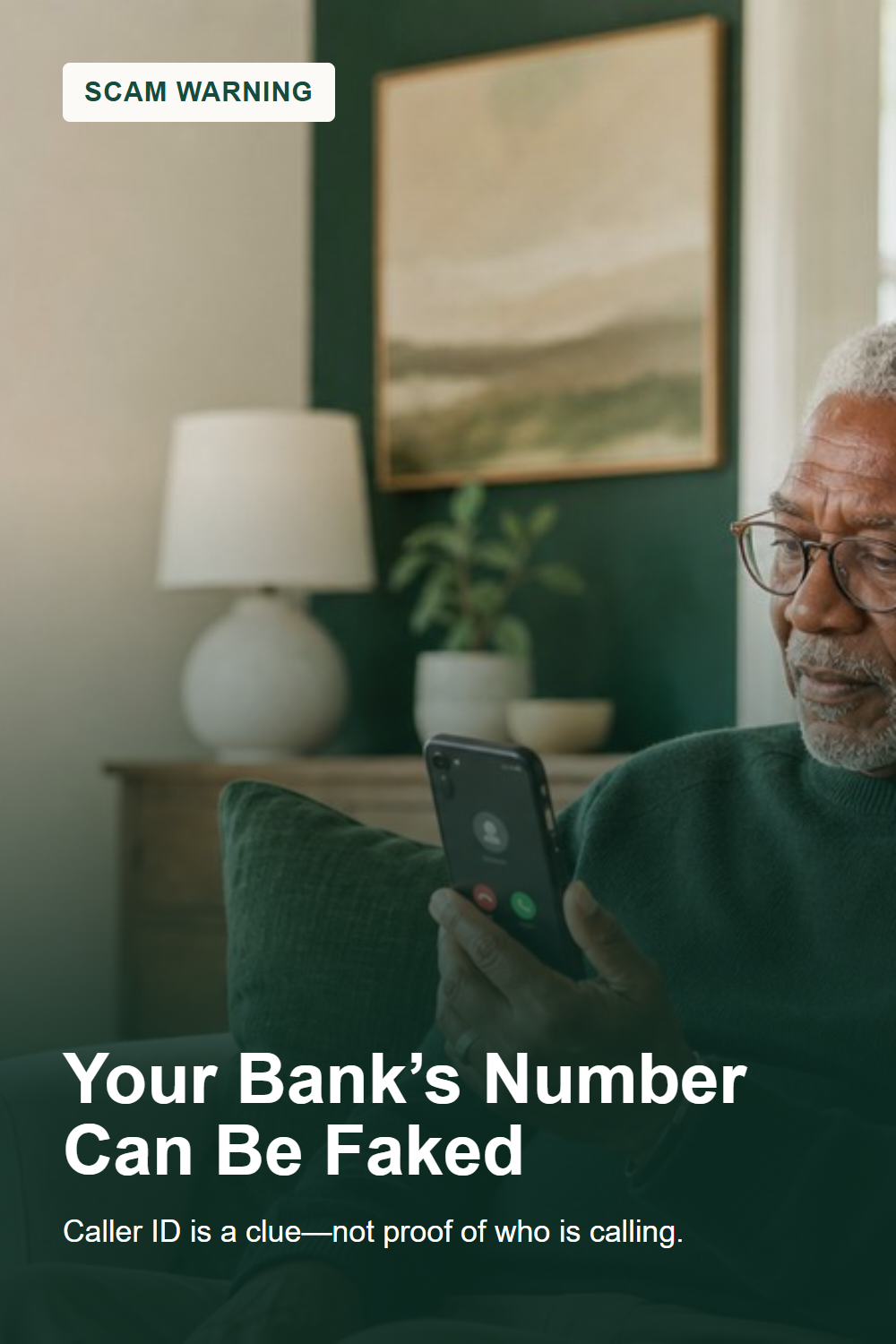
Quick answer: Caller ID spoofing lets a criminal make a fake bank call display a trusted name or number, sometimes even the number printed on your card. The display shows what the phone network was told to present; it does not prove who is speaking. If a bank call is unexpected, end it and contact the bank independently through its official app, website, a recent statement, or the number on your card.
A bank name on your screen is not a security check. It is only a label, and labels can be manipulated.
Imagine Robert, a retired teacher, making tea when his mobile phone lights up with the name of his bank. The caller knows his full name and says a suspicious transfer has been stopped. The voice is patient and professional. Robert is told that a security specialist will protect the rest of his savings, but only if he confirms a code immediately.
Nothing feels chaotic. That is precisely why the call is dangerous. The number looks right, the caller sounds competent, and several familiar signals point Robert toward trust.
This fictional scenario reflects patterns described in official fraud warnings. The names and details are illustrative.
Caller ID spoofing bank scams work by borrowing a familiar identity and then creating pressure before the recipient can verify it. The most useful protection is not memorizing every technical trick. It is adopting one calm rule: an incoming caller never gets to control how you confirm who they are.
What caller ID spoofing is
Caller ID is the name or number shown when a call arrives. Spoofing happens when that information is changed so the call appears to come from somewhere else. The US Federal Trade Commission warns that scammers can make a chosen name or number appear on the display. The real caller may be in another city or country.
In the UK, the Financial Conduct Authority describes number spoofing as changing the displayed caller ID to resemble a genuine bank or organization. Europol’s 2025 position paper likewise explains that manipulated caller information helps criminals make calls and texts appear legitimate.
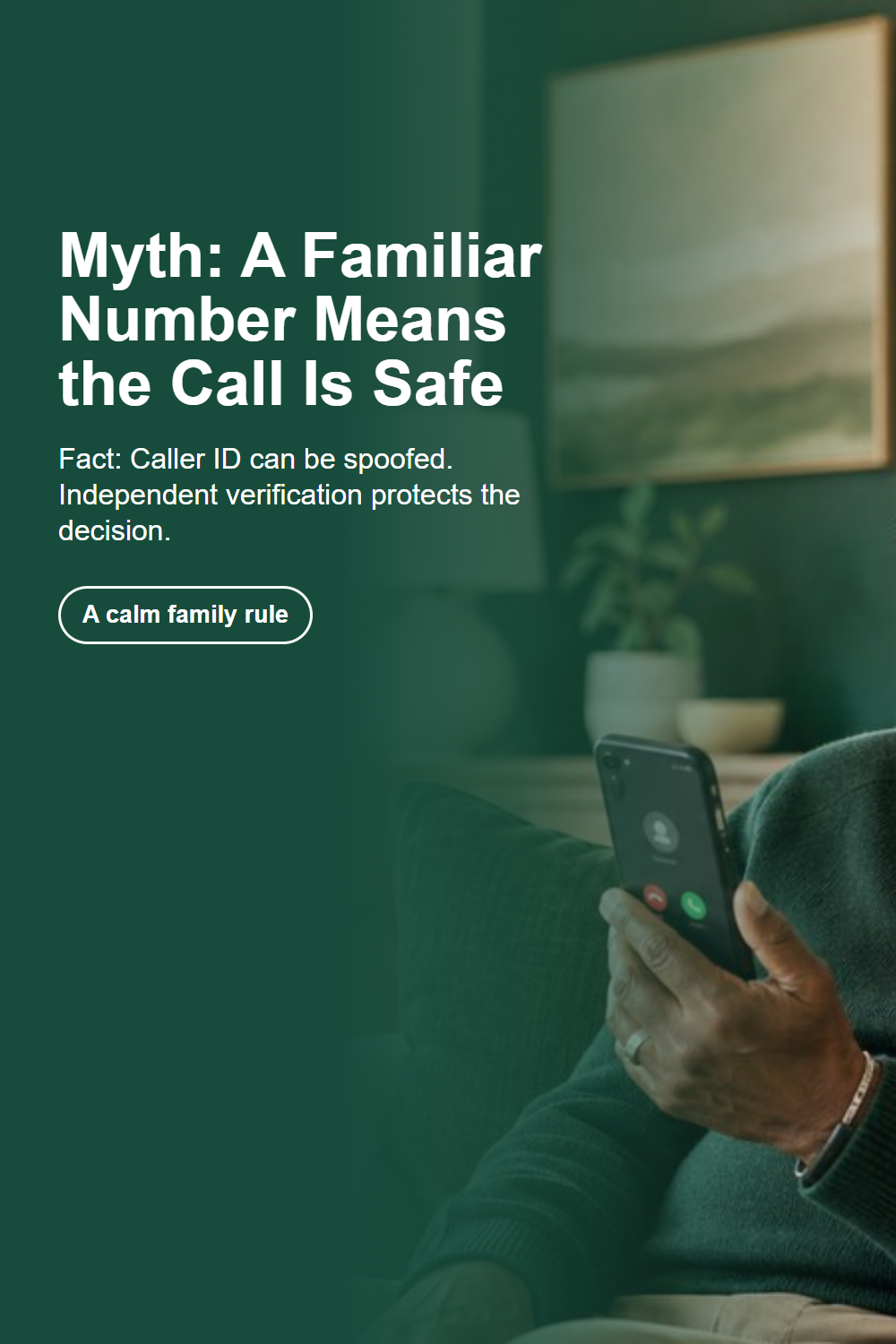
The technology behind a call can be complex, but the family safety lesson is simple. Your screen may accurately display a number while giving you no reliable proof that the caller is entitled to use it. A genuine-looking number and a genuine caller are two different things.
Not every altered caller ID is criminal. A hospital or large company may display a central return number. The useful rule is not “every unexpected call is a scam,” but “verify important calls through a separate route.”
What the phone display proves—and what it does not
A caller ID can help you decide whether to answer. It cannot safely settle a question about money, account access, or identity. Think of it as an envelope with a return address written on the front. The address may be useful, but you would not treat it as a passport.
| Signal | What it may tell you | What it cannot prove |
|---|---|---|
| A familiar bank name | The presented information matches a saved contact or caller database. | That the speaker works for the bank. |
| The number on your card | The displayed digits resemble an official number. | That the call originated from that number. |
| A “verified” or check-mark label | A network or device made a technical assessment. | That the conversation or request is safe. |
| Correct personal details | The caller has obtained information about you. | How the information was obtained or whether the caller is legitimate. |
Caller-authentication and filtering can reduce risk, but they do not turn the screen into an identity document. The Federal Communications Commission accepts complaints about spoofing and illegal calls while noting that defenses cannot stop every harmful call.
The practical rule: Treat caller ID as a clue about the call, never as permission to share a code, disclose account information, install software, approve a notification, or move money.
How a fake bank call builds trust
Effective bank impersonation rarely depends on spoofing alone. The displayed number opens the door; the conversation supplies the rest. Understanding the sequence makes it easier to interrupt.
1. The caller presents a plausible problem
The story may involve a card purchase, new device, transfer, loan application, or “compromised” account. It is specific enough to feel urgent but vague enough to fit many people. If you recently used your card or received a real security alert, coincidence can make the story feel even more convincing.
2. Small facts create borrowed credibility
The caller may know your name, address, bank, phone number, or the last few digits of an account. Information can come from data breaches, social media, stolen mail, marketing databases, earlier phishing, or another victim. Knowledge is not identity. The FTC’s current guidance on unexpected calls about money at risk warns that a caller may know personal or account details and still be a scammer.
3. Professional behavior lowers suspicion
The person may use hold music, a case number, security language, or a second “specialist.” Grammar and accent are poor fraud tests; a calm caller can be dishonest.
4. Urgency narrows your choices
The caller says the transaction is happening now, your account will be frozen, or delay will make recovery impossible. This moves the conversation from “Is this true?” to “Which instruction should I follow?” A genuine fraud problem may require attention, but it can still be checked through the bank’s real channels.
5. The caller takes control of verification
A scammer may tell you not to hang up, may provide a number to call, or may claim the incoming display is proof. They may send a genuine one-time code triggered by an attempted login and then ask you to read it aloud. For a fuller list of prohibited and suspicious requests, use the guide to what banks will never ask you to share by phone.
6. The “solution” benefits the criminal
The final instruction may be to reveal credentials, approve a sign-in, install remote-access software, withdraw cash, buy cryptocurrency, or transfer funds to a so-called safe account. A request to move money to protect it is a decisive reason to stop. The account controlled by the criminal is not a safe place.
How to respond to caller ID spoofing bank scams
You do not need to accuse the caller or win an argument. You only need to end the incoming conversation and start a new, independent one.
- Pause. Put down any pen, stop entering information, and take one breath. A short pause returns the decision to you.
- Share nothing further. Do not confirm a password, PIN, security code, card number, balance, or address. Do not approve an app prompt.
- End the call. Do this even if the caller says the account will be emptied or the call cannot be reconnected.
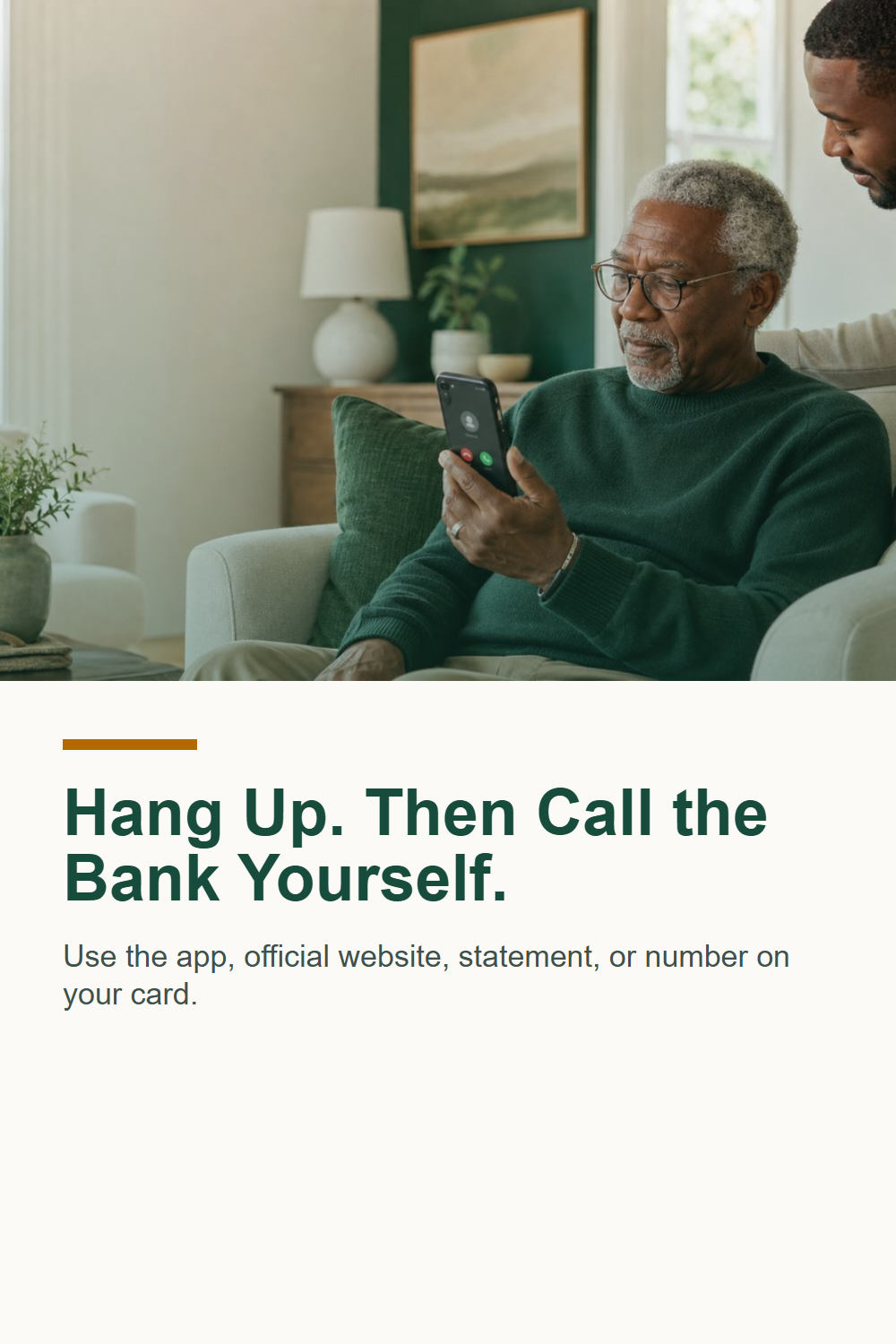
- Choose your own contact route. Open the bank’s app yourself, type the known official website, use a recent statement, or call the number printed on the back of your card.
- Explain what happened. Tell the bank you received an unexpected call, what was requested, and whether you shared or approved anything.
- Record useful details. Note the time, displayed number, exact request, and any transaction or reference number. Do not prolong the scam to collect evidence.
The FTC advises people to get basic details, hang up, and contact the organization independently. Do not rely on a number supplied by the caller or an unverified search result.
Ready-to-use scripts
“I do not handle account security on an incoming call. I will contact the bank through its official app or the number on my card.”
“I understand what you are saying. I am ending this call now so I can verify it independently.”
“I never read security codes aloud. If this is genuine, I will see the issue when I contact the bank myself.”
If pressure makes it hard to think, one sentence is enough: “I will call the bank myself.” Then end the call. You do not owe an unexpected caller politeness at the expense of safety.
How to discuss spoofed bank calls without shaming anyone
Start with the design of the fraud, not the supposed weakness of the person receiving it. Say, “These calls are built to look convincing,” rather than, “You should have known.” That wording keeps attention on a shared defense.
Invite the older adult to choose the verification route and a trusted person to call when something feels wrong. A plan agreed in advance supports independence and open reporting.
A useful ten-minute conversation covers three points:
- No one in the family treats an incoming number as proof of identity.
- Anyone may end a financial call without apologizing.
- No urgent transfer happens until a second trusted person or the bank’s independent channel has been consulted.
Connect this rule to the wider plan for protecting aging parents from AI voice scams. A criminal may combine a spoofed number with a cloned voice or a fake authority figure. Families can also create a private family safe word for personal emergency calls, although a safe word should never replace contacting the bank independently.
Practise once without drama: use the exit script, hang up, and find the correct contact route. The goal is familiarity, not fear.
Make the plan work for hearing loss, memory changes, or reduced mobility
A safety plan should fit the person, not demand perfect hearing, recall, or speed.
- For hearing loss: turn on live captions where available, but do not treat a captioned name as authentication. Keep the exit script in large print beside the phone.
- For memory difficulties: use a short card: “Stop. Hang up. Call the number on the card.” Place it where financial calls are usually taken.
- For reduced vision: use high contrast, large type, and tactile markers to identify the correct bank card or trusted contact.
- For reduced mobility: keep the official bank number and a charged phone within easy reach. Enable trusted-contact features only with the account holder’s knowledge and consent.
When listening is tiring, reduce the decisions required during the call rather than removing the person’s phone.
For older adults living alone
Create a contact ladder with at least two people. If the first person is unavailable, call the second. Agree that a banking decision can wait while someone returns the call. Where supported, use the bank’s in-app secure message or branch appointment instead of an unexpected voice call.
Call blocking can reduce interruptions, but spoofed calls may still get through. Keep the independent-verification rule after filters are enabled.
For families in different countries
Record time zones and the bank’s country-specific channel. The account holder should know how to reach the bank from home, while distant family knows whom to contact locally.
Do not forward account screenshots, codes, or credentials overseas. Relatives can slow the decision or help find official contact information while the owner retains control.
What to do if you shared information or sent money
Act quickly, without blame. Fast reporting can improve the chance of limiting harm, but no one should promise that money will be recovered.
- Contact the bank immediately through an official channel. Ask for the fraud or security team.
- Describe exactly what was exposed: login details, card information, a code, remote access, an app approval, or a transfer.
- Follow the bank’s containment steps. These may include securing online banking, replacing a card, reviewing transactions, or recalling a payment.
- Secure the device. If remote-access software was installed, disconnect the device from the internet and follow trusted technical guidance. Use a different clean device to change important passwords.
- Preserve records. Keep screenshots, messages, receipts, call times, and case numbers. Do not edit the originals.
- Report through the correct national service. Procedures vary, so use current official guidance.
| Location | First financial step | Official reporting route |
|---|---|---|
| United States | Contact the bank or payment provider promptly. | FTC ReportFraud; use the FCC complaint route for unwanted calls or spoofing concerns. |
| England, Wales, Northern Ireland | Contact the bank first when banking or card details are involved. | Report Fraud vishing guidance. Follow its current reporting instructions. |
| Scotland | Contact the bank first. | Use Police Scotland’s official fraud guidance; call 101 for non-emergencies. |
| European Union | Contact the bank or payment provider immediately. | Report to the relevant national police or cybercrime and consumer-protection service. |
In the UK, Report Fraud’s June 2026 advisory says an official-looking number does not prove a genuine call. Ofcom likewise advises people to disengage, hang up when in doubt, and report suspicious calls.
Caller ID spoofing bank-scam checklist
- I know that a familiar bank name or number can be spoofed.
- I will not share a password, PIN, security code, or app approval on an incoming call.
- I will not move money to a “safe account.”
- I can end a call even when the caller sounds professional or urgent.
- I know where to find my bank’s official contact route.
- I will not use a number supplied by the caller.
- I have one exit sentence ready.
- I have a trusted person I can contact before an unusual transfer.
- I know the first reporting step for my country.
Review the warning signs of an AI emergency call as well. Secrecy, blocked verification, unusual payment methods, and relentless urgency are warning signs across many kinds of impersonation fraud.
Frequently asked questions
Can a scammer make my bank’s real number appear on my phone?
Yes. Official consumer and law-enforcement guidance warns that caller ID information can be changed to resemble a genuine bank or organization. End the call and contact the bank through a route you choose independently.
If the number has a check mark, is the call safe?
No technical label should be treated as permission to share secrets or move money. Authentication and spam-filtering systems can help, but they do not validate every statement or request made during a conversation.
Will a real bank ever call me?
A bank may call about genuine activity. The safe distinction is not “banks never call.” It is that an unexpected caller should allow you to end the conversation and reconnect through the bank’s official channel. Bank procedures vary, so follow your own bank’s published advice.
What if the caller knows my recent transactions?
End the call anyway. Detailed knowledge may come from compromised accounts, messages, paperwork, or earlier fraud. Contact the bank independently and explain what the caller knew so the security team can assess it.
Should I call back the number shown in my recent-call list?
No. That repeats the number presented by the incoming call. Use the bank’s app, official website, recent statement, or number printed on your card instead.
Can I waste the scammer’s time or collect evidence?
It is safer to end the call. Prolonging it creates more opportunities for manipulation and may reveal additional information. Record what you already observed and report it through official channels.
What should I tell an aging parent after a suspicious call?
Begin with support: “That call was designed to look genuine. I’m glad you paused.” Then verify the account together without taking over. If anything was shared, focus on the bank and reporting steps before discussing how to strengthen the plan. Use this guide to discuss scams with aging parents without shaming them.
Trust the method, not the display
A spoofed call succeeds when the screen makes the decision before the conversation begins. The answer is a verification method that belongs to you: end the incoming call, choose the contact route, and give yourself time.
Caller ID spoofing bank scams may look polished, local, and reassuring. None of those qualities changes the rule. A genuine problem will still exist when you contact the bank yourself. A scammer’s advantage often disappears the moment you do.
Build the Complete Family Protection Plan
My full-color guide, Protect Aging Parents from AI Voice Clones, Fake Bank Calls and Online Scams, includes realistic scenarios, ready-to-use scripts, checklists, emergency-response pages, and a practical 7-Day Family Protection Plan.
About the author
Michael Onoja is a Microsoft MVP, technology leader, software engineer, researcher, and published author. He writes about AI safety, digital trust, cybersecurity, and practical ways families can protect one another from emerging online threats.
Read more AI safety and digital-trust articles.
Educational disclaimer: This article provides general educational information, not legal, financial, banking, or law-enforcement advice. Bank procedures and reporting routes vary. Contact your bank and the appropriate official service for guidance on your circumstances.
Save and share these bank-call safety reminders
Keep these visual reminders on your phone or share them with a parent, relative, or friend. Each one reinforces the safest response to an unexpected bank call: stop, hang up, and verify independently.